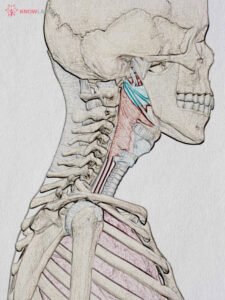
Superior Constrictor of the Pharynx
Superior Constrictor of the Pharynx
☆constrictor pharyngis superior
MusclePro
Anatomy
- Origin
-
The four parts of this muscle arise from:
- the lower third of the posterior margin of the medial pterygoid plate and its hamulus (Pterygopharyngeal part)
- from the pterygomandibular raphe (Buccopharyngeal part)
- from the alveolar process of the mandible above the posterior end of the mylohyoid line (Mylopharyngeal part)
- and by a few fibers from the side of the tongue (Glossopharyngeal part)
- Insertion
- The fibers curve backward to be inserted into the median raphe, being also prolonged by means of an aponeurosis to the pharyngeal spine on the basilar part of the occipital bone. The superior fibers arch beneath the levator veli palatini muscle and the Eustachian tube.
- Nerve
- Pharyngeal branch of the vagus nerve (CN X) via the pharyngeal plexus.
- Actions
- As soon as the bolus of food is received in the pharynx, the elevator muscles relax, the pharynx descends, and the constrictors contract upon the bolus, and convey it downward into the esophagus. They also have respiratory mechanical effects.
This entry is part of Knowlative Pro
The full entry includes: 3 images · 1 muscle test · 5 balancing items · 9 connections.
Knowlative PRO, with every entry and every connection, opens soon. Subscribe to the newsletter to be the first to know.